Pinglu Canal Lock Hubs: Madao, Qishi and Qingnian
How three twin-line lock hubs — Madao, Qishi and Qingnian — lift 5,000-tonne ships down a 65-metre drop to the sea, and Madao's world-record water-saving lock.
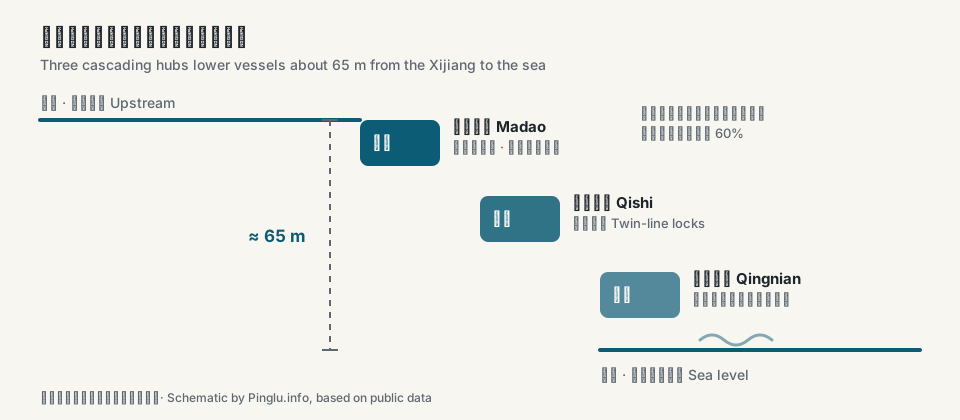
Between its starting point and the sea, the Pinglu Canal descends about 65 metres — more than a 20-storey building. Three cascading navigation hubs, Madao, Qishi and Qingnian from upstream to downstream, act as the water stairs that let 5,000-tonne vessels make that descent.
Why three hubs?
The canal joins inland river levels to sea level across a 65-metre drop. Each hub holds back a reach of the canal with twin-line ship locks that raise or lower vessels in stages. The hubs also divide and regulate water along the route — without them, neither the Class I channel standard nor 5,000-tonne navigation would be possible.
Madao hub: the controlling work
Madao, in the upstream Nanning section, is the canal's controlling hub and its largest single work. According to the Guangxi government press conference, its ship lock set two world records: the largest water-saving inland ship lock and the greatest water-level difference handled by a water-saving lock.
A water-saving lock recycles the water released at each lockage into side basins and reuses it for the next fill. Public reports put the water saving at around 60% per operation — critical for keeping the canal's long-term water balance sustainable.
Qishi hub: the mid-route link
Qishi hub sits mid-route in the Lingshan county section of Qinzhou, carrying the middle step of the descent and tying the upstream water level set by Madao to the lower reaches. Like Madao and Qingnian, it is built with twin-line locks, so ships can be locked up and down simultaneously.
Qingnian hub: the last lock before the sea
Qingnian hub lies downstream, close to Qinzhou, and is the last hub vessels pass before the sea. Once through its locks, vessels are at near-sea level and enter the river-sea transition waters of Qinzhou Bay, heading for the seaport terminals at Qinzhou Port.
In May 2026, installation of the hubs' steel structures was completed, marking the full completion of the main works; the hubs entered service with the canal's opening on September 16, 2026.
Hub locations and the route →Shipping & river-sea transport →
More than navigation
Although built for shipping, the three hubs also serve flood control, ecological and water-resource functions along the Qinjiang valley — part of why the project is classified as a combined water-conservancy and navigation scheme.
- Lock hubs
- 3 — Madao / Qishi / Qingnian
- Lock layout
- Twin-line ship locks
- Total drop
- ≈ 65 metres
- Madao hub
- World's largest water-saving inland lock (official)
Sources (public reports, as of September 2026)
OfficialMinistry of Transport of China2026-09-08
Facts about the Pinglu Canal's construction (Guangxi press-conference coverage)View original ↗
OfficialGuangxi Zhuang Autonomous Region Information Office2026-09-07
Guangxi government press conference on the canal's opening
MediaCCTV (CCTV.com)2026-05-16
Main works of the three navigation hubs fully completed
MediaNanguo Morning Post2026-09-23
Water-saving ship lock explainer at the Education Center
Hub parameters follow official press conferences and major media (as of September 2026); official engineering documents prevail.