Pinglu Canal Shipping & Logistics: A New River-to-Sea Route
How the Pinglu Canal reshapes southwest China's access to the sea: launched cargo routes to Vietnam and Hainan, river-sea transshipment at Qinzhou Port, cost savings and ASEAN trade.
The Pinglu Canal's core purpose is shipping: it connects the Xijiang river system directly to the Beibu Gulf, giving southwest China its first inland-waterway route straight down to a seaport. This page summarizes the publicly reported picture for shippers and logistics professionals. This site offers no freight brokerage, quotations or dispatch services.
Why the canal changes the map
Guangxi faces the sea, but its major rivers flow east: until 2026, waterborne cargo from Nanning and the wider Xijiang basin had to sail all the way through Guangdong to reach the ocean. Public estimates cited in official releases suggest the canal cuts the inland leg of that journey by about 560 km, with overall logistics costs projected to fall by 18–30% on affected flows and projected annual transport-cost savings of more than CNY 5 billion.
For riverside industries, bulk-friendly water transport now reaches the sea directly. One vehicle maker cited in public reports estimates its new river-sea route via the canal cuts its logistics costs by roughly 10%.
Cargo routes already launched
On opening day, September 16, 2026, two cargo routes began bidirectional service, per CCTV citing the Guangxi transport authorities: a domestic route linking Nanning with Yangpu Port in Hainan (building materials, grain and manufactured goods), and a foreign-trade route linking Nanning with Can Tho, Vietnam — opening a direct river-sea lane for machinery, light-industry and agricultural exports, and for ASEAN imports moving upstream.
Ports and river-sea transshipment
Three names are easy to mix up, so it helps to separate them. The Pinglu Canal itself is the waterway — the channel linking the Xijiang river system to the sea. The Beibu Gulf port group is Guangxi's coastal port system, of which Qinzhou Port — the canal's direct outlet — is a core port. Actual cargo handling takes place at individual seaport terminals inside Qinzhou Port. Public data put the port group's 2025 cargo throughput at about 358 million tonnes and container throughput above 10 million TEU.
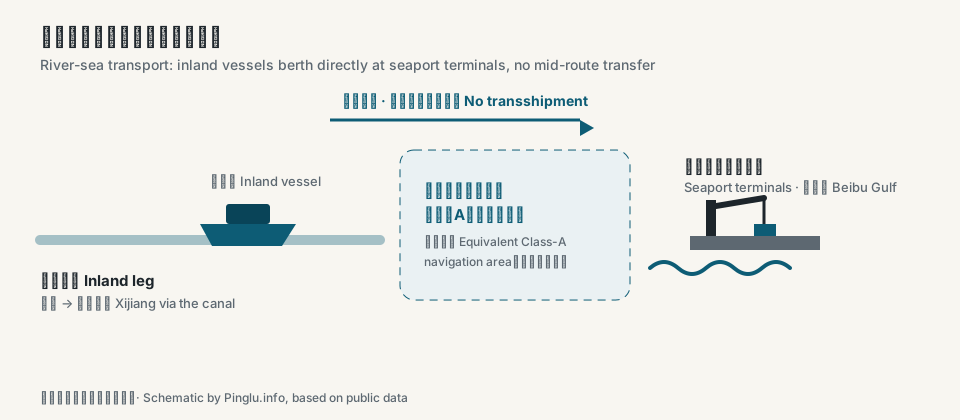
How do inland vessels reach a seaport terminal? Per the Ministry of Transport, China's first "equivalent Class-A navigation area" has been designated in the river-sea transition zone of Qinzhou Bay. Inland vessels that meet the relevant conditions can sail from the canal straight into these waters and berth at Qinzhou's seaport terminals, without changing ships mid-route.
That is what river-sea transport means in practice: the inland leg and the maritime leg join up in a single through movement, so cargo is not unloaded and re-shipped at an intermediate port. For Southwest China, this is the piece that turns the canal's shorter route into real logistics value — berths, storage and rail-and-road hinterland connections at the port determine how much of the distance saving actually reaches shippers.
Guangxi authorities have also announced multimodal investments — terminals, rail spurs and lock coordination — so the canal complements the rail and road corridors of the New Western Land-Sea Corridor. Container river-sea services and rail-water combinations are worth watching in future releases from the Ministry of Transport and the Beibu Gulf port group.
The route and the sea outlet →The three lock hubs →Read the FAQ →
ASEAN Trade and Regional Connectivity
The canal flows south toward Southeast Asia, and official positioning describes it as a water corridor linking western China to the Beibu Gulf and, beyond it, ASEAN. Cargo that transits the canal arrives at Qinzhou Port on the gulf, where it can connect with ocean services to Vietnamese and other ASEAN ports — placing China's southwest far closer, in shipping terms, to its fastest-growing trading partners.
The first connections came on opening day. On September 16, 2026, per CCTV and People's Daily reports, a foreign-trade river-sea route linking Nanning with Can Tho, Vietnam began service — a direct lane for machinery, light-industry and agricultural exports heading downstream, and for ASEAN imports moving upstream.
Multimodal combinations are following. In September 2026, per public reports, Sichuan ran its first "Sichuan — Pinglu Canal — Vietnam" rail-river-sea service: freight moved by rail to Nanning, was loaded onto vessels, transited the canal and sailed on to Can Tho. Early services like this are only a beginning — schedules and coverage will take time to settle, and the picture is worth following through official releases.
Latest shipping updates
Per Xinhua, on September 24, 2026 the "Beigang Nanning Borun" — the first cargo vessel of the Nanning–Can Tho foreign-trade route — arrived at Can Tho Port, Vietnam. Carrying 252 TEU, she departed Nanning's Liujing terminal on September 16 (the day the canal opened), anchored off Can Tho on September 23 and was welcomed at an arrival ceremony on September 24.
The voyage completed the first full run of the canal's first foreign-trade route, moving the "Nanning — Can Tho" river-sea service into actual operation. A domestic route to Yangpu Port in Hainan opened alongside. Sailing frequency and port calls are subject to the shipping company's and operator's further notices.
Xinhua: first cargo vessel reaches Can Tho (external link) ↗
Lock fee policy (published terms)
- Trial standard in force: from the canal's opening date to September 30, 2031, the trial vessel lock fee is CNY 1.0 per gross tonne per passage;
- The operator may apply differentiated discounts within the trial fee cap, based on season, vessel type and other factors;
- Check the latest notices from the competent authorities and the lock operator.
Who should pay attention
- Bulk shippers in southwest China (construction materials, grain, minerals, chemicals): a new low-cost sea access route;
- Manufacturers and traders selling to ASEAN: direct river-sea lanes toward Vietnam and beyond, with lower cost and shorter distance;
- Logistics and shipping companies: new river-sea and multimodal combinations through Beibu Gulf ports;
- Investors in port-side industry: official plans call for canal-side industrial parks and a maritime-economy belt along the route.
- Sea route shortened
- ≈ 560 km (official estimate)
- Logistics costs
- Projected −18–30% on affected flows
- Sea gateway
- Qinzhou Port · Beibu Gulf ports
- Lock fees
- CNY 1.0/GT per passage (trial to Sep 30, 2031)
Sources (public reports, as of September 2026)
OfficialMinistry of Transport of China2026-09-17
Pinglu Canal officially opens to navigationView original ↗
MediaXinhua (chinaview.cn)2026-09-24
First cargo vessel of the Pinglu Canal's first foreign-trade route reaches Can Tho Port, VietnamView original ↗
OfficialMinistry of Transport of China2026-09-08
Facts about the Pinglu Canal's construction (route shortening of ~560 km, 18–30% logistics-cost estimates, equivalent Class-A navigation area)View original ↗
MediaCCTV2026-09-25
First-week operations after the opening
OfficialGuangxi Zhuang Autonomous Region Information Office2026-09-07
Guangxi government press conference on the canal's opening
MediaSichuan Online2026-09-04
Pinglu Canal multimodal trains: first Sichuan service departs, a new southern artery for the New Western Land-Sea CorridorView original ↗
Industry and policy information compiled from public sources (as of September 2026); not business advice. No freight brokerage, rates or dispatch services are provided.